Creating a Highly Scalable Dev[Sec]Ops Pipeline
![Creating a Highly Scalable Dev[Sec]Ops Pipeline](https://storage.ghost.io/c/29/e8/29e8d033-5f2d-4993-a0f9-ff337d469c41/content/images/size/w1200/2026/06/devsecops-pipeline-featured-1.png)
Building a DevOps (Security included) pipeline that doesn’t crumble under the weight of a growing engineering team requires moving away from “bespoke” scripts and toward a factory-model architecture. If your pipeline fails when your team size doubles, it isn’t scalable, it’s high-maintenance.
This document focuses on concepts and is intended for young engineers or startups trying to get a good understanding on how to scale your pipeline. Here are the four core concepts that I have learned that will help you build a pipeline capable of scaling to any size.
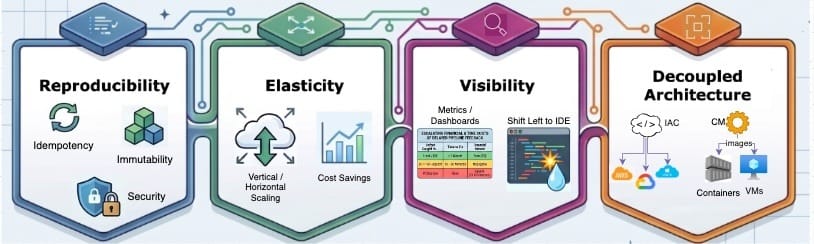
1. Reproducibility: The "Immutable" Standard
In a highly scalable pipeline, Reproducibility is your insurance policy. If you can’t recreate your environment exactly, you don’t have a pipeline; you have a collection of lucky accidents. If a build works on a developer's laptop but fails in staging, the pipeline isn't scalable.
Removing "Snowflake" Changes
A "snowflake" is a server or environment that has been manually tweaked over time until it is unique and impossible to replicate. This includes UI changes to any service in the pipeline (Github/Actions changes, AWS console changes, Grafana Dashboard changes, etc)
- The Concept: Move from Mutable (changing things on the fly) to Immutable (replacing the whole unit).
- The Solution: There should be no UI access to make any changes to the pipeline. All changes have to be done via code and the CI/CD pipeline pushes the change to any component in your pipeline.
For example, make an image change to the codebase and check it in and your CI tool builds the new image and places it in the container registry.
Another example is creating grafana dashboards in json, checking it into your repository and then CI deploys your dashboard to Grafana.
Even your development environment should be managed via code; using a declarative tool that defines the end state of your development environment (local applications, IDE settings, containers, etc) makes onboarding and environment setup a breeze.
Disaster Recovery (DR)
In a scalable system, "Disaster Recovery" shouldn't be a 48-hour manual process involving backups and prayer. It should be an action that can rebuild your entire infrastructure with one push of a button
- The Concept: If your entire cloud region goes offline, reproducibility allows you to stand up an identical infrastructure in a different region using only your code repository.
- The Solution: Using Infrastructure as Code (IaC) like Terraform, you simply change a region variable and run an apply. Within minutes, your entire architecture is recreated exactly as it was.
Security & Compliance
When environments are reproducible, security becomes a "hard" constraint that is baked in, rather than a "soft" hope.
- The Concept: You create a "Golden Path." By ensuring every environment is built from the same reproducible templates, you ensure that security patches and compliance settings are present everywhere.
- The Solution: If a vulnerability is found in a base OS image, you update the "Gold Image" in your pipeline, and the next build automatically rolls out the patch to every service.
2. Elasticity: Scaling the Pipeline, Not Just the App
Before we dive into elasticity, here is a harsh truth: If your pipeline isn’t reproducible, it can never be elastic. You cannot auto-scale a manual process. Once you have an immutable standard, true elasticity transforms your pipeline from a fixed bottleneck into a fluid utility.
System Resiliency: The Self-Healing Pipeline
- The Concept: Treat your CI/CD runners as "cattle, not pets." If a node fails, it shouldn't require an alert and a reboot; it should be seamlessly destroyed and replaced.
- The Solution: Use orchestrators like Kubernetes to manage build agents. If an agent crashes midway through a heavy test, the orchestration layer instantly provisions a new pod to retry the job. The pipeline heals itself before a developer notices.
Cost Optimization (Paired with Intelligence)
- The Concept: A static pipeline costs money 24/7, even when everyone is asleep. An elastic pipeline scales down to zero at night and scales up to handle massive loads during the day.
- Intelligent Execution: Pair elasticity with intelligent compute purchasing. For critical PR checks, use standard instances. For nightly end-to-end regression tests, the pipeline can request Spot Instances, reducing your CI/CD bill by up to 90%.
Dynamic Parallelization (Handling the "Thundering Herd")
- The Concept: As your team grows, you will encounter the "thundering herd" problem: 50 developers all pushing code right before a code freeze. Static pipelines queue these sequentially. Elastic pipelines fan out the work.
- The Solution: Instead of one agent taking 45 minutes to run 10,000 unit tests, an elastic pipeline dynamically provisions 45 ephemeral agents, divides the test suite among them, and returns the result in 1 minute. The compute cost is identical, but the feedback loop is instantaneous.
3. Pipeline Visibility and Feedback: The Engine of Iteration
Now you have an engine that is reproducible and elastic, the next step is to have visibility because without visibility and feedback, you are flying blind.
Radical Visibility: No More Black Boxes
Every stage of the pipeline must emit telemetry. Developers should be able to look at a dashboard and instantly know the health of the pipeline. Track DORA Metrics:
- DF - Deployment Frequency
- MLTC - Lead Time for Changes
- CFR - Change Failure Rate
- MTTR - Time to Restore Service
If a build fails, the pipeline should post a direct, contextual message to the developer via a collaboration messaging tool (e.g., "Build Failed in Staging: Integration Test #42 timed out...").
Shifting Left: Catching Fire Before It Spreads
"Shifting Left" means moving your security, compliance, and quality checks as early in the software development lifecycle as possible.
- Linting: Enforce coding standards directly in the IDE and via pre-commit hooks.
- Security: Integrate Static Application Security Testing (SAST) and Software Composition Analysis (SCA) directly into the Pull Request or IDE. If a developer accidentally hardcodes a secret, the PR is automatically blocked.
The Economics of Instant Feedback
The most expensive resource in any engineering organization isn't cloud compute; it's developer context switching and sitting idle.
- The Cost of Waiting: If a pipeline takes 45 minutes to run checks, a developer moves on to a new task. If it fails, they must stop, mentally load the previous context, fix the bug, and wait again.
- The Profit of Speed: Instant feedback keeps developers in the "flow state." If a security scan fails in 15 seconds, the developer fixes it immediately while the code is fresh in their mind.
4. Decoupled Architecture: Future-Proofing the Runtime
As your platform scales, almost all the technology choices you made during the MVP phase will inevitably be challenged. A pipeline that is tightly coupled to one specific application or technology is a pipeline that may eventually have to be rewritten.
It is important to have an abstraction layer between all stages of your pipeline (this includes the runtime platform)
The "MVP Lock-in" Trap: Containers vs. VMs
- Concept: During the MVP phase, it is common to build all automation around a single runtime (like Docker on Kubernetes). But if a high-performance database needs to move out of containers and onto dedicated VMs, a tightly coupled pipeline becomes a massive engineering hurdle.
- Solution: Use a tool that gives you the same interface to manage both runtime environments - Terraform/Pulumi can manage both kubernetes and cloud platforms so they good tools to use to as an abstraction layer for the runtime environment
The Helm Dilemma
Helm is a fantastic package management tool for Kubernetes. However, it only speaks Kubernetes.
- Concept: If your architecture evolves to require both containers and VMs, Helm cannot manage the VMs. You are forced to use multiple tools, breaking visibility, increasing cognitive load and context switching.
- Solution: If you are going to scale and need multiple platforms then it is better to leverage a tool that gives you more flexibility like Ansible
Configuration Management (CM) as an Abstraction Layer
To achieve loose coupling, use Configuration Management tools (like Ansible, Chef, or Puppet) as a universal abstraction layer. Remember that the entire pipeline is code and you have to manage them just like you would manage your application.
- You write your application configuration logic once in a CM playbook.
- When the pipeline runs, it uses a tool like Packer to execute that single playbook.
- Need a container? Packer uses the CM playbook to build a Docker image. Need a VM? Packer uses the exact same CM playbook to bake a cloud AMI.
- The OS-Agnostic Bonus: CM tools use declarative, OS-agnostic modules. If security mandates a move from Ubuntu to RHEL, your logic doesn't break. The CM tool handles the OS differences automatically.
Telemetry Collection Abstraction
- Concept: Telemetry is another aspect of your pipeline that should be abstracted.
- Solution: Leverage open standards like open-telemetry so your applications have a standard way of sending data to the collector. Telegraf in the TICK Stack (by Influxdata) is a good open-source telemetry aggregator. It can receive from and send to open-telemetry clients and a vast number of clients and backends. This makes it flexible even if you don’t use the TICK stack for telemetry.
Conclusion: The Pipeline Equation
Building a scalable DevOps pipeline isn’t just about chaining tools together; it is about architecting a system that can handle growth, failure, and change. If we distill all of this down to a single formula, it looks like this:
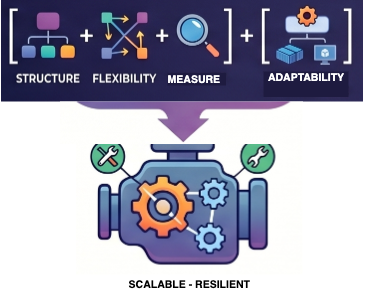
- Structure (Reproducibility): You create a standard. You define your infrastructure, your builds, and your security baselines as immutable code.
- Flexibility (Elasticity): When demand surges or a node fails, your pipeline dynamically allocates resources to heal itself and keep moving then adjust back to the standard.
- Measure (Visibility): Through instant feedback, metrics, dashboards and automated guardrails, you instantly know when a commit breaks the mold.
- Adaptability (Decoupled Architecture): As your needs change you can swap out any part of your pipeline and it does not affect anything upstream or downstream.
When you combine a system that enforces a standard, monitors that standard, has the elasticity to maintain it, and allows underlying parts to be swapped out—you no longer have a fragile deployment script. You have an engineering engine capable of scaling to any size.
The next logical step is to add Agentic AI to monitor and maintain the engine!